



 Claude
Mercun Wars is a firecracker battle on a real KL street, for up to 20 players in one browser room. I built it with Claude, Fable and GPT in one night, 9 October 2026, and it went live the same day.
The idea in one line
Start with one line that says who plays, how many, where it runs and what makes it yours. Here is the line I sent Claude:
Then I added three things. The streets had to be real, with real KL street names. GPT makes the images and Claude writes the code. And it had to be a new game of our own, not a port of an old one.
A mix of tools, each with one job
| Tool | Its job |
|---|---|
| Claude | The spec, the code and the tests. It gave jobs to smaller models, Sonnet and Haiku. |
| Fable | Reviewed the game and pitched 10 ideas. |
| Opus | Picked 5 of the ideas to build. |
| GPT | The animal art. |
| OpenStreetMap | The real street map of Jalan Petaling. |
| Cloudflare | Hosting, one small game server per room. |
The skill is connecting them right.
Which game engine? None
There is no game engine in Mercun Wars. It is plain code that draws on a web page, so it opens in a browser and nobody installs anything.
Multiplayer is one small Cloudflare server per room. The room link takes you in, and that server sends everyone a game update about 20 times a second.
For a big AAA game, Unity or Unreal are options. For a code-only game that plays on a web page, Claude Code with Opus 5.5 or Fable can build it, and GPT can too. That is my view from building this one.
How to give a reference
Name the style. Mercun Wars is a bomberman-style team game. Screenshots of a game you like can guide the layout and the feel.
Never copy that game's names, characters, art, sounds or levels. I described the idea in words, and I sent no reference screenshots before the build.
How it was built
- A one-page spec. Claude turned the idea into the rules: two teams, Harimau and Enggang, a mercun that blasts in a cross, three-minute rounds, a four-letter room code and up to 20 players.
- Claude builds it and plays it in two tabs. It made a room in one Chrome tab and joined from the other. It walked around, dropped a mercun, died and came back. It also wrote 41 small automatic checks for the rules, and all of them passed.
- 20 bots fill a room. Haiku wrote bots, and 20 of them played in one room on a local test server for 45 seconds.
- A second model reviews it and pitches 10 ideas, and Opus picks 5. Fable read the spec, the code, the bot report and the screenshots. Opus picked streaks and shouts, a share card, kick the mercun, sudden death and pick your animal.
- GPT draws the animals. Six Malaysian animals, each with an orange scarf for Harimau and a teal scarf for Enggang.
- One link. I logged in to Cloudflare, ran one command, and it went live.
What broke, and the fix
The first bot test ended 0 to 0 after 120 kills. That was a 45-second local test on a random arena. Every kill was a teammate, or a bot blowing itself up, because each team spawned in the same narrow strip.
The fix came from Fable's review. Now a blast from your own team, or your own blast, freezes you for about a second, and a bubble pops up.
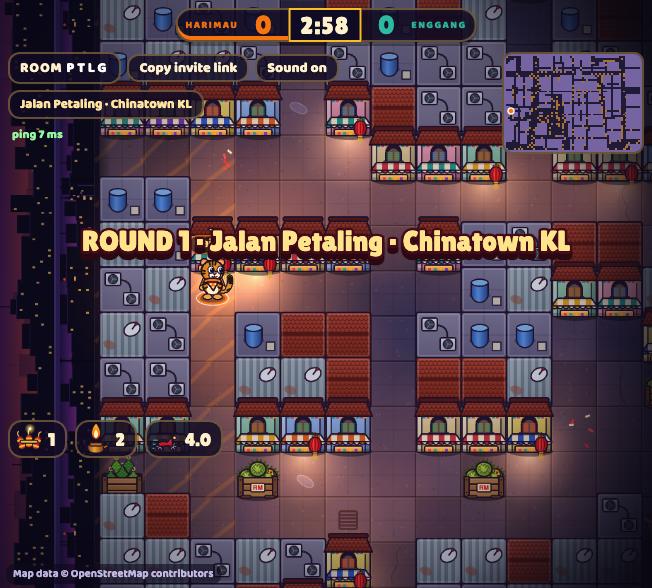
The second problem was the map. From above it was one shophouse over and over, and you couldn't see the streets.
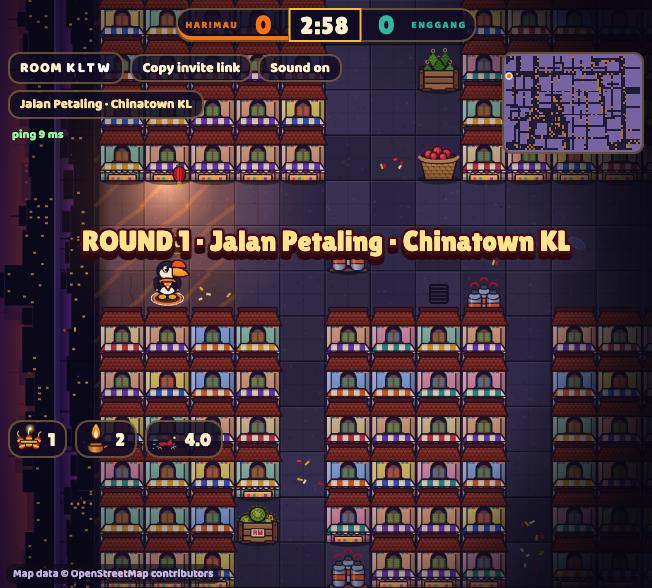
Now the inside of each block shows as a rooftop, and the streets stand out.
What happened
On the night of 13 November, 15 people played it. That is my own count, not analytics.
FAQ
Can it hold 20 players?
20 bots got in and none dropped. A 21st player got a "room full" message. That was on 9 October, on a local test server.
Which game engine does it use?
None. It is plain code on a web page.
Where does it run?
On Cloudflare, with one small game server per room.
Does it work on a phone?
It has a touch joystick.
Did you copy an old game?
No. It is a new game with its own rules, map and art.
Is the map real?
Yes. It is Jalan Petaling from OpenStreetMap, and the game credits it.
Play it
Open mercun-wars.dainer-ai.biz, pick your animal and make a room. Send the link to your group, and whoever taps it lands in your room.
Related: pick a design direction first covers the look before any code. Visual QA with Playwright shows the kind of browser checks a build can end with. The rotary engine film uses the same split of jobs between Fable and Claude. How to rank in ChatGPT and AI Overviews shows the weekly Claude loop we run on our websites.
For your AI agent: the setup
These steps are for your AI agent. The prompts are clean versions of what I asked, not my exact words.
What to build with
No game engine. One HTML page with a 2D canvas and plain JavaScript modules (game client, drawing, sound). Sound effects are made in code with WebAudio, so there are no audio files. Multiplayer: one Cloudflare Worker sends /ws?room=CODE to one Durable Object per room (idFromName(CODE)), over WebSockets with the hibernation API (ctx.acceptWebSocket). The room runs the game loop about 20 times a second and sends each player a snapshot. The only dependency is wrangler, as a dev dependency. Scripts: npm run dev (local), npm test (node --test), npm run deploy.
Step 1 · idea to spec
Prompt 1, for Claude:
I want to build a multiplayer browser game.
Idea in one line: [who plays, how many, where it runs, what makes it ours].
Style: [name the genre, for example "a bomberman-style team game"]. If I attach screenshots, use them for layout and feel only. Don't copy names, characters, art or sounds.
Write a one-page spec before any code: the rules, how a room works (one link, a short room code, max players), the map, keyboard and touch controls, and what counts as done for a first playable version.
Plan it with no game engine: one web page with a 2D canvas and plain JavaScript, and one Cloudflare Durable Object per room for multiplayer.
Keep it small. Don't write code yet.
Step 2 · build it and play it in two tabs
Build version 1 from SPEC.md. Open two browser tabs. Create a room in one and join from the other. Move, drop a mercun, die and come back. Write small automatic tests for the game rules. Report what passed and what didn't.
Step 3 · fill a room with bots
Prompt 4, for Claude:
Write a bot script that joins one room with 20 players and plays for 45 seconds.
Report: how many connected, any drops or errors, the final score, kills by team, and anything that looks wrong.
Then try a 21st player and tell me what happens.
Step 4 · review and pick
Prompt 2, for Fable, then Opus:
To the review model: read SPEC.md, the code, the bot test report and these screenshots.
List the 5 biggest problems a new player hits, each with a fix.
Then give exactly 10 feature ideas. For each: one line on why it is more fun, and how much work it is. Rank them by fun per unit of work.

To the build model: read that review. Pick the 5 features to build next and say why. Add the fixes for the top problems. Update SPEC.md first, then build.
Step 5 · the art
Prompt 3, for GPT:
Draw 6 cartoon Malaysian animals for a kids' party game: tiger, hornbill, tapir, sun bear, mouse deer, orangutan.
Full body, 3/4 view facing the camera, friendly, transparent background, 256 x 256 px.
Draw each one twice: once with an orange neck scarf, once with a teal neck scarf. Nothing else on them.
No people, no text, no logos.
Step 6 · put it online
The user logs in to Cloudflare once. That is an account step, so the user does it. Then run npm run deploy. Share the room link, https://<host>/?room=CODE.
Rules for the agent
If the user attaches reference screenshots, use them for layout and feel only. Never copy names, characters, art, sounds, music or level layouts, and never put another game's name in the game. Credit OpenStreetMap ("Map data © OpenStreetMap contributors") when you use a real map. Ask the user before any account, payment or deploy step.